

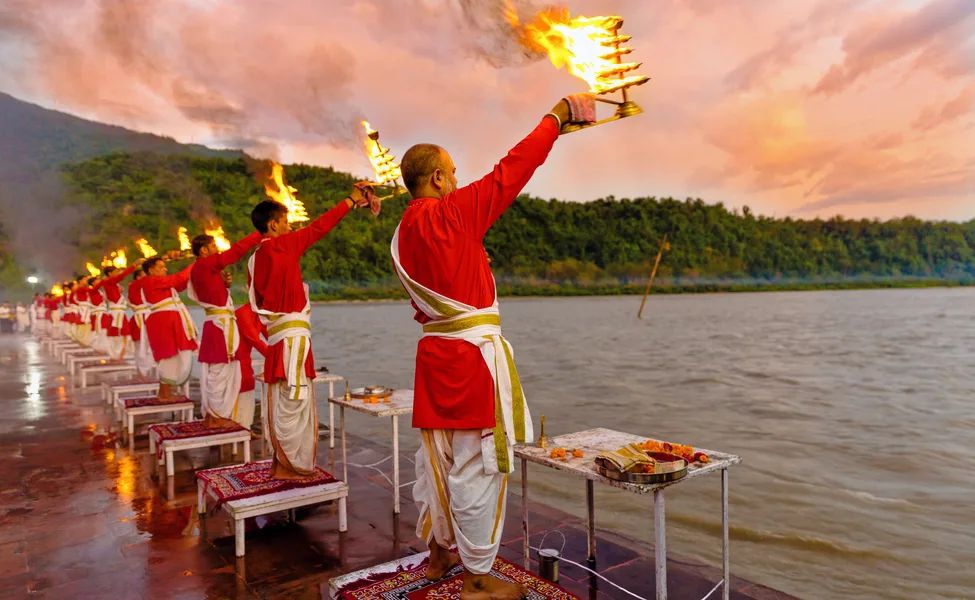
Two words “Hari” and “Dwar”. ‘Hari’ means God and ‘Dwar’ means Gate. Haridwar means Gateway to the God.
Haridwar is an ancient pilgrimage site situated in the foothills of the shivalik range in Garhwal Himalayas. Its latitude and longitude are 29.96 degrees north and 78.16 degrees east respectively. Haridwar is situated at the height of 249.7m from the sea level. Haridwar city is spread over 12.5 sq. kms and lies between the Shivalik hills in the north and north-east and the Ganges river in the south.
Haridwar is one of the primary areas where river Ganges emerges from the mountains and enters to the plain areas. Haridwar is place where the river Ganges enters in plain areas north India after flowing 250 km from its origin Gaumukh (Gangotri Glacier).
It is situated 30 kms south west from Rishikesh and 90 kms south from Mussoorie and 220 kms east from Delhi.
A sacred destination where people from across the India visit for pilgrimage and to take a holy dip into the holy river Ganges. An ancient and one of the most sacred cities for Hindu religion in India.
Foreigners always attracted to Haridwar because here they can closely experience India's complex culture, various Hindu rituals and the ancient civilization.
It is Gateway for the four Dhams of Himalayas viz. Gangotri, Yamunotri, Kedarnath and Badrinath.
The legendary King Bhagirath, great grandson of the King Sagar of Suryavanshi clan (an ancestor of Lord Rama), is said that he brought the river Ganga down from heaven, through his long penance of many years, for the salvation of the souls of his 60,000 ancestors from the curse of the sage Kapila. The penance was answered and the river Ganges trickled out from Lord Shiva's locks and its ample holy waters rejuvenated the 60,000 sons of King Sagara. Sage Kapila lived here in his ashram so this place was also known as Kapilsthan. The tradition which was established by King Bhagirath is now followed by thousands of Hindu devotees, who bring the ashes of their departed family members, in hope of their salvation by the water of river Ganges.
It is believed that nectar (Amrit) which was one of the fourteen valuable ornaments that came out from the sea churning (Samundra Manthan) was sprinkled at 12 places in the entire universe. Out of that 12 places 08 places are in heaven and only 04 places on earth. Har-Ki-Pauri in Haridwar was one of the four places where Amrit was sprinkled on earthr. As a result, every 12 years Khumbh Mela comes to Haridwar and draws more than half a million pilgrims. The Ardha Kumbha Mela comes once in every six years.
Apart from religious importance Haridwar is also a centre for learning different arts and culture. A great source of Ayurvedic medicines and herbal remedies “Patanjali Ayurvedic”. A new home to the Indian tradition of teaching "Gurukula." ‘Gurukula Kangri Vishwavidyalay’, A Gurukul system since 1902.
Haridwar is divided in several small areas such as Mayapur, Ranipur, Jwalapur, Har Ki Pauri, Motichur, Devpura, Bhupatwala, Haripur Kalan, Shivalik Nagar, and Brahampuri.
The vast majority of the district is surrounded by forests and Rajaji National Park comes within the boundaries of the district, making it the ideal place for wildlife and adventure lovers.
 ॐ इन्द्रं वर्धन्तो अप्तुरः कृण्वन्तो विश्वमार्यम् । अपघ्नन्तो अराव्णः ॐ ।।
ॐ इन्द्रं वर्धन्तो अप्तुरः कृण्वन्तो विश्वमार्यम् । अपघ्नन्तो अराव्णः ॐ ।।
ॐ इन्द्रं वर्धन्तो अप्तुरः कृण्वन्तो विश्वमार्यम् । अपघ्नन्तो अराव्णः ॐ ।।
ॐ इन्द्रं वर्धन्तो अप्तुरः कृण्वन्तो विश्वमार्यम् । अपघ्नन्तो अराव्णः ॐ ।।
ॐ इन्द्रं वर्धन्तो अप्तुरः कृण्वन्तो विश्वमार्यम् । अपघ्नन्तो अराव्णः ॐ ।।
ॐ इन्द्रं वर्धन्तो अप्तुरः कृण्वन्तो विश्वमार्यम् । अपघ्नन्तो अराव्णः ॐ ।।
ॐ इन्द्रं वर्धन्तो अप्तुरः कृण्वन्तो विश्वमार्यम् । अपघ्नन्तो अराव्णः ॐ ।।
ॐ इन्द्रं वर्धन्तो अप्तुरः कृण्वन्तो विश्वमार्यम् । अपघ्नन्तो अराव्णः ॐ ।।
ॐ इन्द्रं वर्धन्तो अप्तुरः कृण्वन्तो विश्वमार्यम् । अपघ्नन्तो अराव्णः ॐ ।।
ॐ इन्द्रं वर्धन्तो अप्तुरः कृण्वन्तो विश्वमार्यम् । अपघ्नन्तो अराव्णः ॐ ।।
ॐ इन्द्रं वर्धन्तो अप्तुरः कृण्वन्तो विश्वमार्यम् । अपघ्नन्तो अराव्णः ॐ ।।